Open-source infrastructure for sovereign AI discovery.
An open specification and a generic platform any country, city, telco or public-infrastructure operator can deploy to create a sovereign registry of locally relevant AI resources - it points to them, never hosts, executes or intermediates them.
The trusted discovery layer for sovereign AI
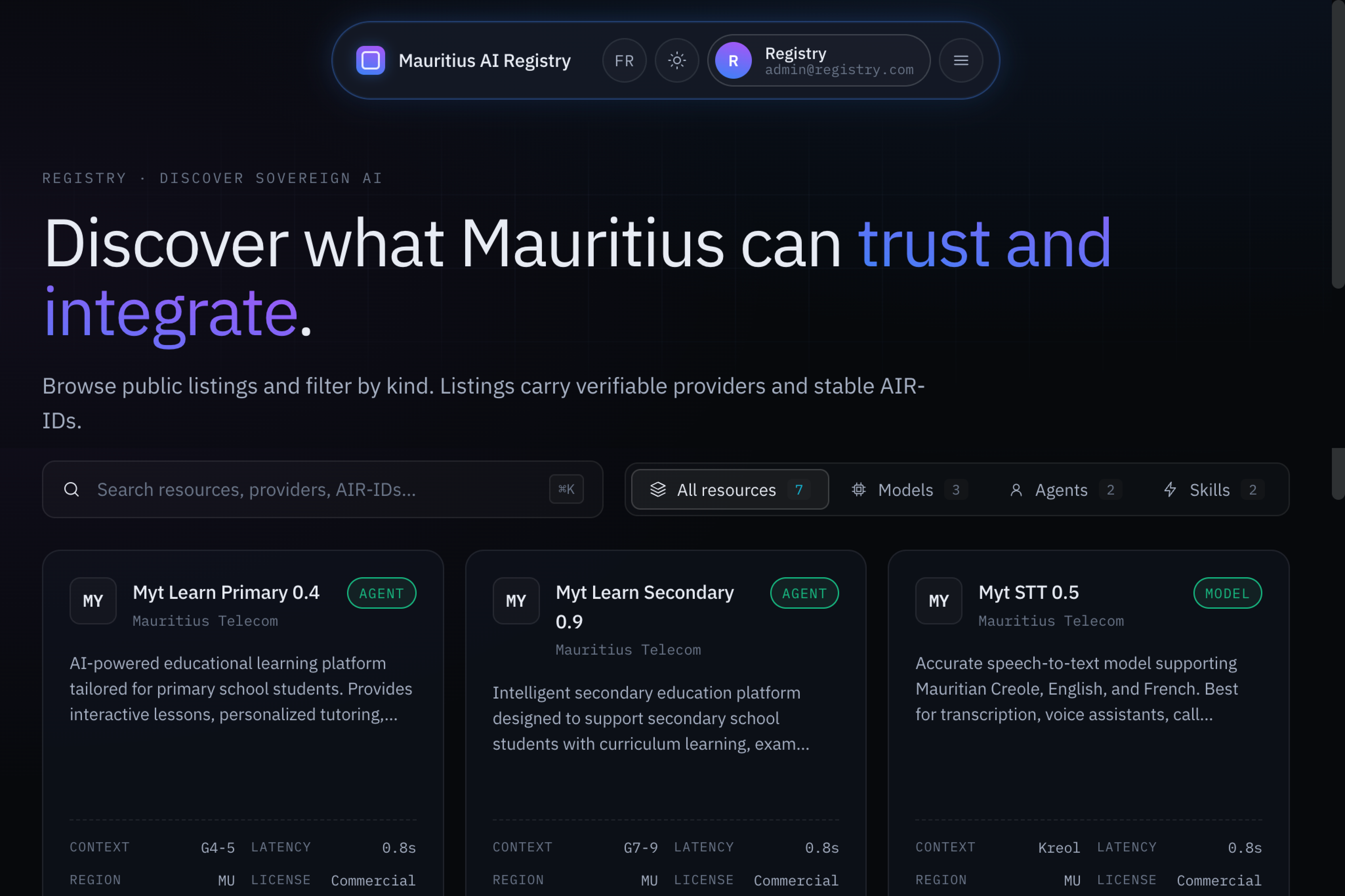
An AI Registry tells people, developers and AI systems what sovereign AI resources exist, who provides them, why they're locally relevant, and where to find them. It exposes structured metadata and stable identifiers.
Three resource types.
Composable by AI.
A registry covers three kinds of sovereign AI resource - models, agents and skills. Each has its own listing template and stable AIR-ID, so consumers and AI systems can find and combine them programmatically. Each resource must meet a published sovereignty test.
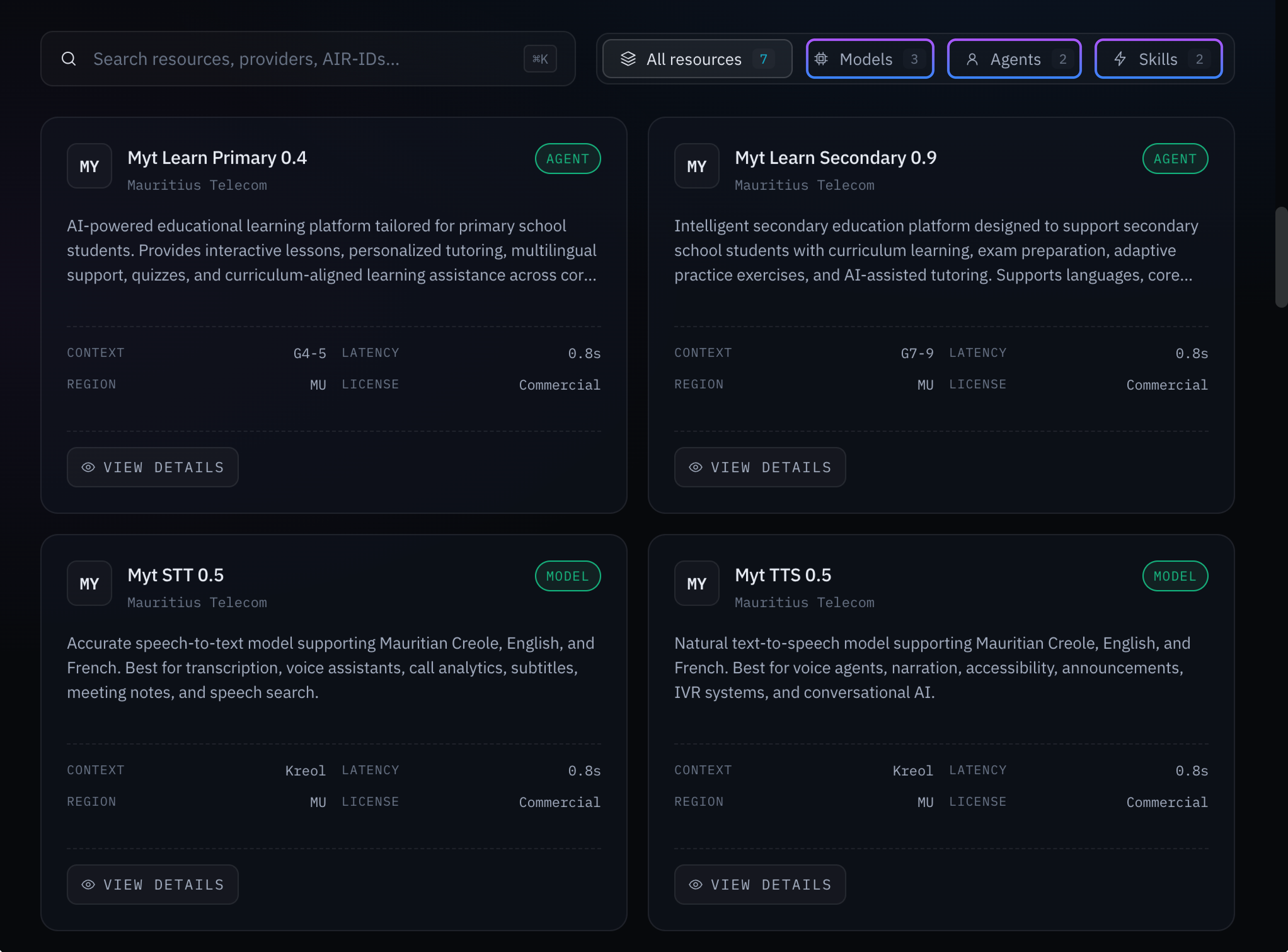
Models
Language, vision or domain models trained on or aware of local context, language and norms.
Agents
AI systems that perform tasks in a local context - registrations, filings, public-service navigation.
Skills
Packaged local expertise that AI systems can load and use - tax, legal and accounting workflows.
The sovereignty test.
A submission must cite at least one sovereignty basis and provide concrete evidence - a referenced law, dataset, institution, language asset or cultural artefact. Reviewers apply a published checklist before elevating a resource's status.
Local law
Encodes local legislation, regulation, official process or professional obligation.
Local data
Uses local datasets, records or locally collected knowledge.
Local systems
Integrates with or describes local institutional systems and workflows.
Local language & culture
Supports local language, culture, norms or context.
From submission to use.
Six transparent steps.
Submit
Provider submits the resource with metadata and sovereignty evidence.
Review
Reviewer applies the sovereignty rubric and records reviewer notes.
Publish
Operator publishes the listing and issues the stable AIR-ID.
Discover
Consumer finds the resource through the portal or discovery API.
Use
Consumer calls the provider directly - runtime never touches the registry.
off-registry · direct to providerMaintain
Provider keeps metadata accurate; status reflects any changes over time.
Govern the registry end to end.
Review submissions against the sovereignty rubric, publish listings and issue stable AIR-IDs, manage providers and branding, and track every change through a complete audit trail.
- Submission review & sovereignty checklist
- Publishing & AIR-ID issuance
- Provider & branding management
- Full audit log


Submit and manage your resources.
Onboard as a verified provider, submit models, agents and skills with sovereignty evidence, and keep listing metadata current.
- Guided submission workflow
- Sovereignty evidence upload
- Listing status & updates
Set up a sovereign registry
in minutes.
Node 20+, pnpm 9+ and PostgreSQL 14+ (a bundled compose file provisions one). Clone the reference implementation, set your jurisdiction, and run.
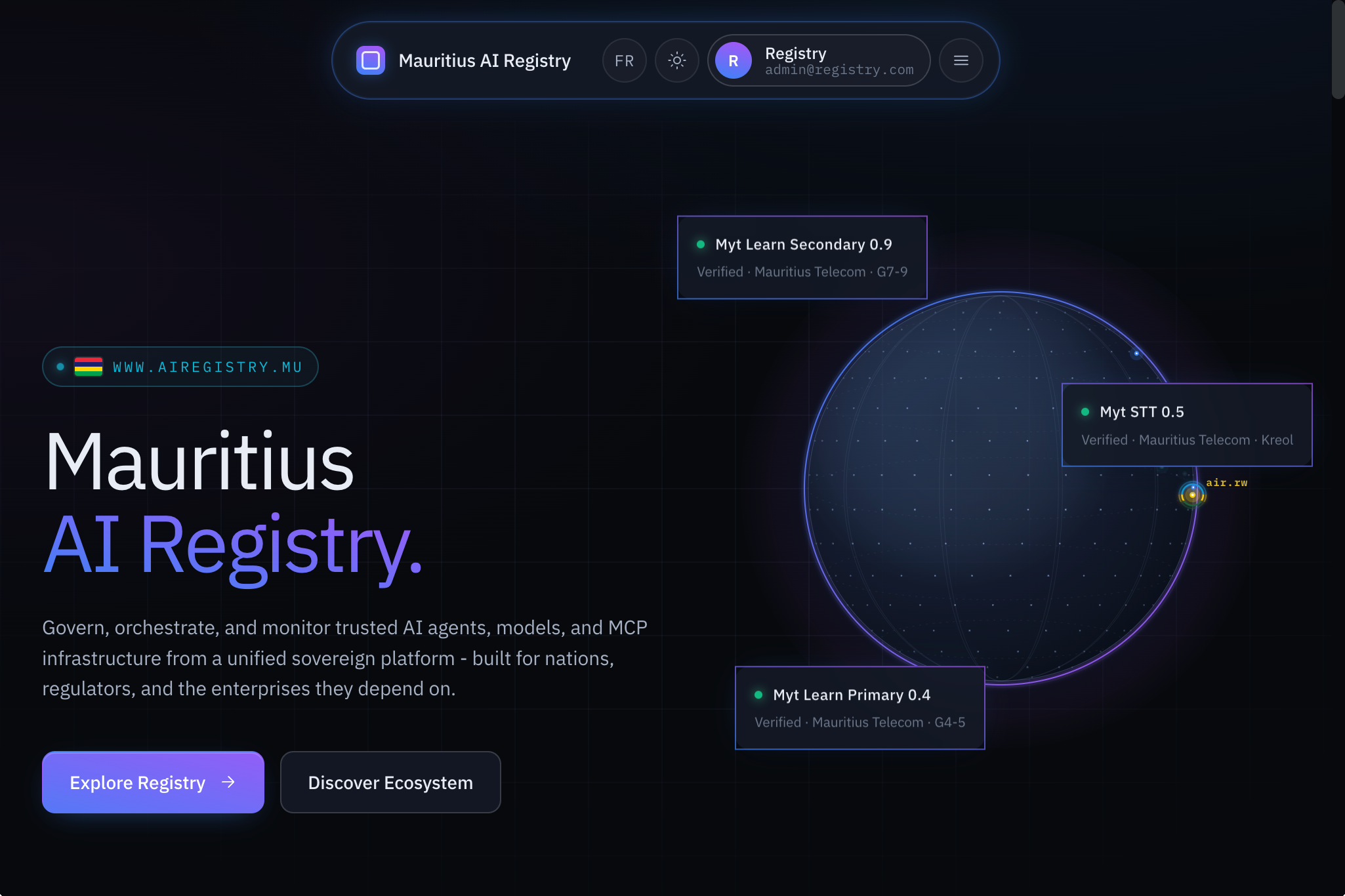
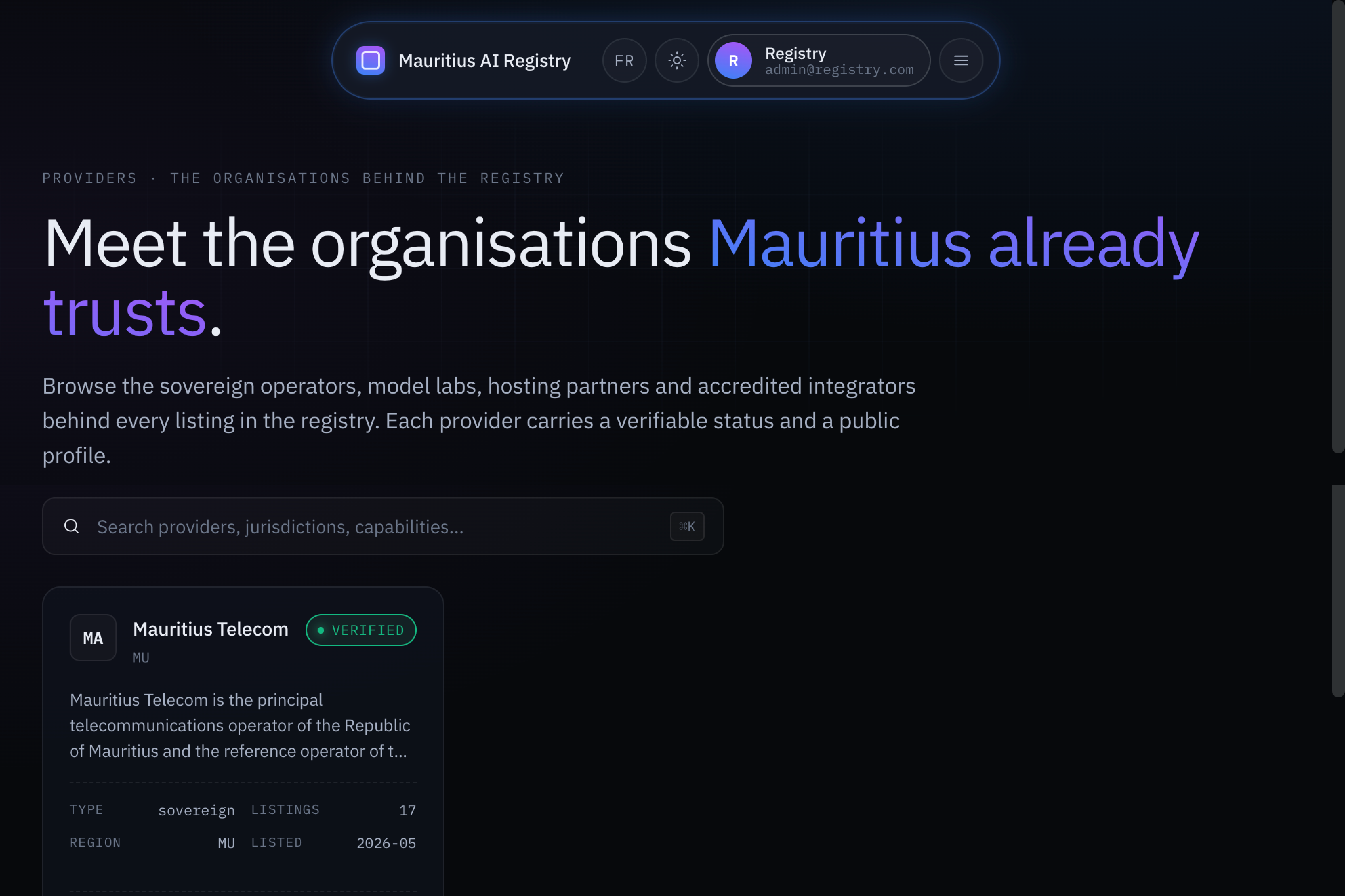
Spearheaded by Mauritius Telecom.
airegistry.mu is the live reference deployment - the first instance, and the proof the platform works in production.
Built to be forked.
Contributions are welcome from across the digital public infrastructure community.
Frequently asked questions.
Deploy a sovereign registry.
Deploy the open-source reference implementation, configure it for your jurisdiction or ecosystem, and publish trusted AI resources in one discoverable place.